The KPIs explained
A KPI (key performance indicator) is a single number a sensor computes from a raw measurement to summarise a machine's condition. You see KPIs as trends in Condition and as the subject of most events. This page explains what the common ones mean and what a rising value tends to indicate.
Vibration KPIs
| KPI | What it is | A rising value often means |
|---|---|---|
| Velocity RMS | The overall energy of the vibration velocity signal. The primary indicator for most rotating machinery, and the basis of ISO limits. | General deterioration — imbalance, misalignment, looseness, bearing wear. |
| Acceleration RMS | The overall energy of the acceleration signal; emphasises higher-frequency content. | Early-stage bearing or gear problems, which show up at high frequency first. |
| Peak-to-peak (P2P) | The full swing from the most negative to most positive value in a measurement. | Impacts and shocks — looseness, hitting, severe defects. |
| Zero-to-peak (Z2P) | The largest deviation from zero. | Similar to P2P; peak severity of the signal. |
| Kurtosis | A statistical measure of "spikiness" — how impulsive the signal is. | Impacting faults such as early bearing defects, which add sharp spikes before overall levels rise. |
| Crest factor | The ratio of peak to RMS — how peaky the signal is relative to its average energy. | Developing impulsive faults; a high crest factor with normal RMS is an early-warning pattern. |
| RPM | Rotational speed, derived from the magnetic-field signal (given a pole-pair count). | Not a fault indicator itself, but the running speed that spectrum peaks are read against. |
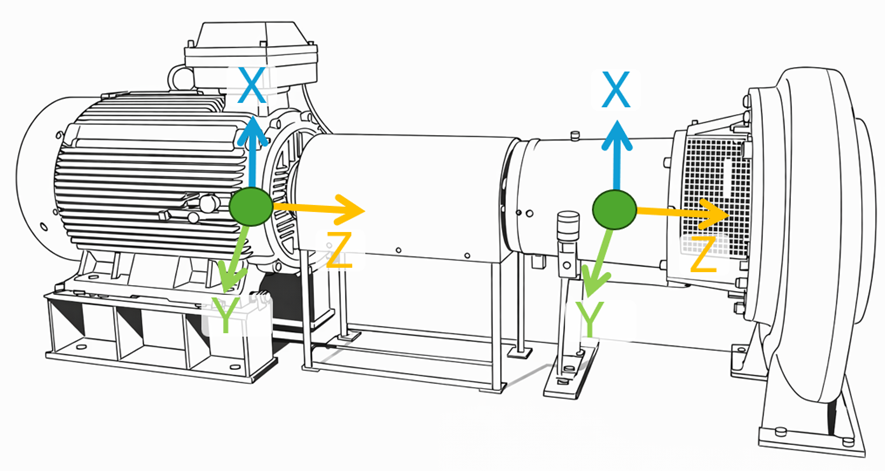
Vibration KPIs are computed per axis (X, Y, Z) where the sensor measures multiple axes, because the direction of a problem is itself diagnostic (e.g. misalignment often shows axially). The axis directions follow the sensor's orientation on the machine:
Which KPIs your machines have depends on the sensor
Treon Industrial Node X (Treon Make) captures triaxial vibration and computes the full set above, plus magnetic field for electric-motor diagnostics. Treon Industrial Node C (Treon Flow) is a KPI sensor that reports velocity RMS and acceleration RMS with temperature. See Overview of solutions.
Temperature
Surface temperature trends complement vibration: rising temperature can indicate friction, lubrication problems, or electrical faults, and often corroborates a vibration trend.
Reading a KPI trend
You watch KPIs as trends on a measurement point's Trends (KPI) tab in Condition. Pick the KPIs and a time range; where a class is assigned, its Warning and Alert limits are drawn on the chart so you can see how much headroom a machine has.
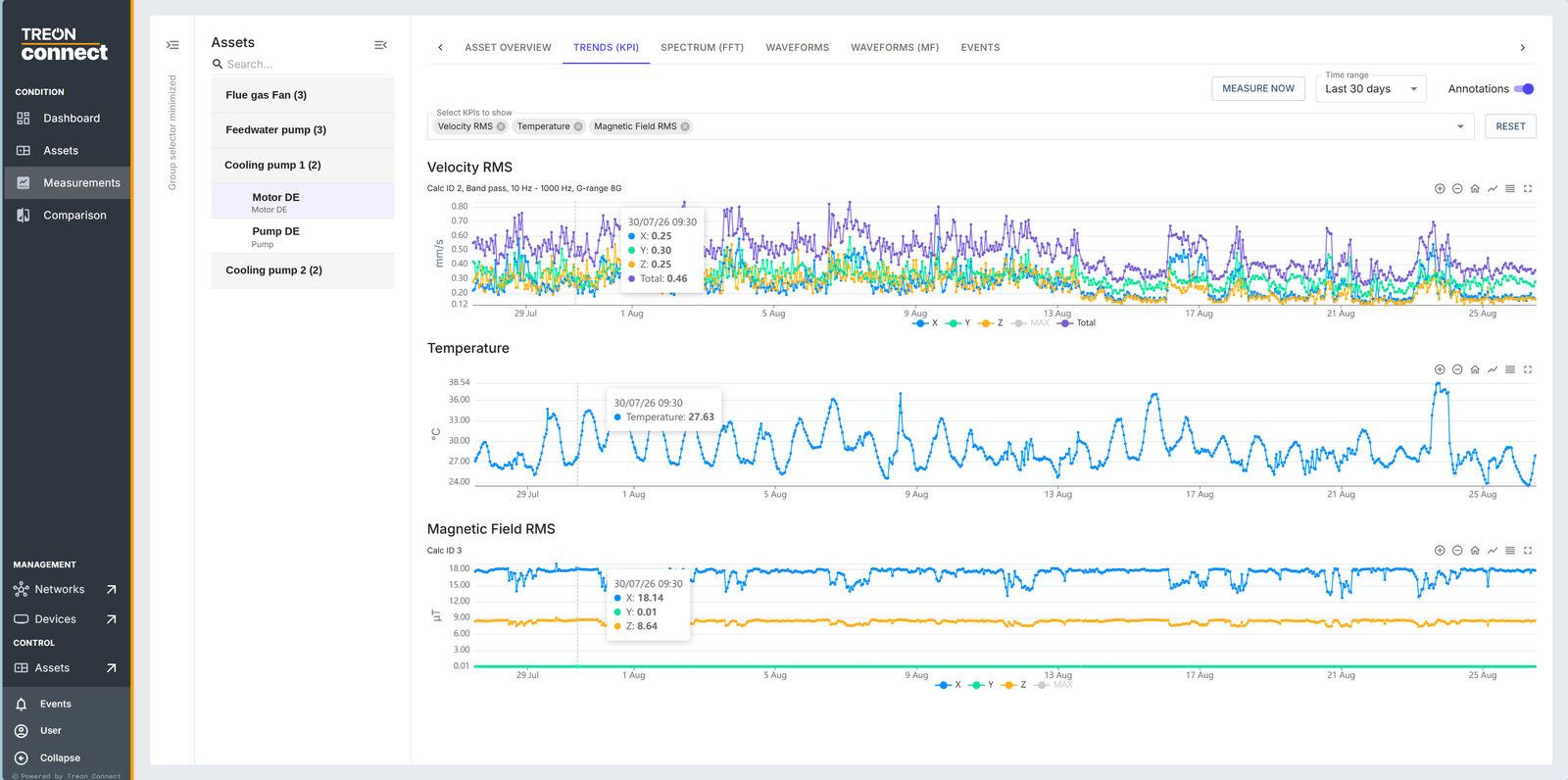
- The trend matters more than the absolute number. A steadily rising KPI on a previously flat machine is a signal even before it crosses a limit — which is exactly what AI anomaly detection is built to catch.
- Compare a machine to its own history and to similar machines (Comparison).
- To find the cause behind a rising KPI, drop into the spectrum and waveform.